


BY RAKESH SINHA
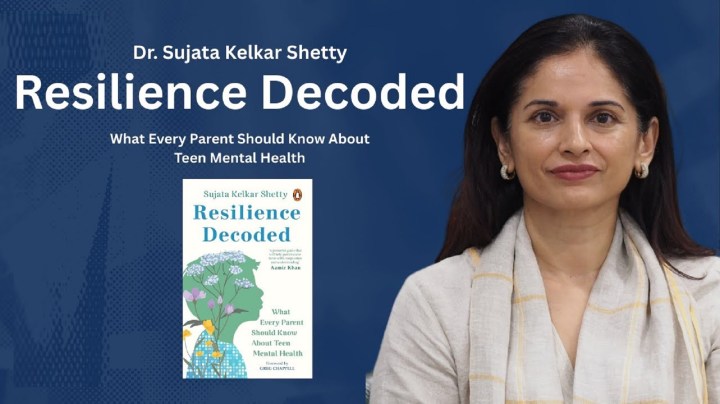
Parenting in the modern age can feel like navigating a relentless storm of academic pressure, social media, and bewildering adolescent behaviour. Dr Sujata Kelkar Shetty’s Resilience Decoded, published by Penguin Random House, arrives as a much-needed lighthouse, cutting through the fog with the precision of a scientist and the warm, pragmatic wisdom of a mother who has been in the trenches.
The book’s relevance to the Indian context was powerfully underscored at its recent launch event, Building Teenage Mental Resilience, held at the Bangalore International Centre on September 6th, 2025. The discussion, which can be viewed on the BIC website, featured the author in conversation with two formidable voices: host Rohini Nilekani (Chairperson, Rohini Nilekani Philanthropies & Director, EkStep) and Pavitra Chalam (Documentary Filmmaker). Their dialogue illuminated the critical need for a science-backed, compassionate approach to nurturing young minds in today’s complex world.
Dr Kelkar Shetty, a biological scientist trained under stress research pioneer George Chrousos at the NIH, performs a rare feat in this book. She makes the development of the adolescent prefrontal cortex as engaging as a compelling narrative, while remaining immensely practical. Her central metaphor of the teenage ‘Ferrari brain’—equipped with Nobel-laureate horsepower but often driven by the impulse control of a caffeinated squirrel—is a game-changer. It reframes teenage forgetfulness and risk-taking not as personal failings or deliberate defiance, but as natural neurological events, a perspective that alone has the power to salvage countless parent-child relationships.
Resilience Decoded excels in its balanced approach. It pointedly avoids both generational nostalgia—the idea that today’s youth are uniquely fragile—and techno-panic that vilifies smartphones. Instead, Dr Kelkar Shetty treats adolescence as a biological phase to be understood, not a problem to be solved. Her chapter on digital resilience is particularly masterful; concepts like the ‘digital sunset’ establish tech boundaries not as draconian punishment, but as common-sense self-care.
The author’s communication advice, especially the deceptively simple ‘listen first, fix later’ maxim, cuts through the noise of modern parenting. The insight that most teenage outbursts are not problems demanding immediate solutions but emotions needing witness is a paradigm shift. As noted in the review, “She transforms teenage mistakes from crimes requiring punishment into experiments yielding data – a shift that could revolutionise every school and household.”
Ultimately, this is a book about inoculation against life’s inevitable stumbles. It proves that resilience is not a mysterious birthright but an “ordinary magic” cultivated when science meets compassion at the kitchen table.
For Indian parents striving to guide their children through the high-stakes maze of adolescence, Resilience Decoded is both a compass and a first-aid kit. It is a masterclass in building the fortitude our children need to not just survive, but thrive.
Dr Sujata Kelkar Shetty’s ‘Resilience Decoded’ is available now. Watch the book launch discussion at the Bangalore International Centre here.
 COUNTRY SQUIRE INDIA