

BY DR KAUSTAV BHATTACHARYYA
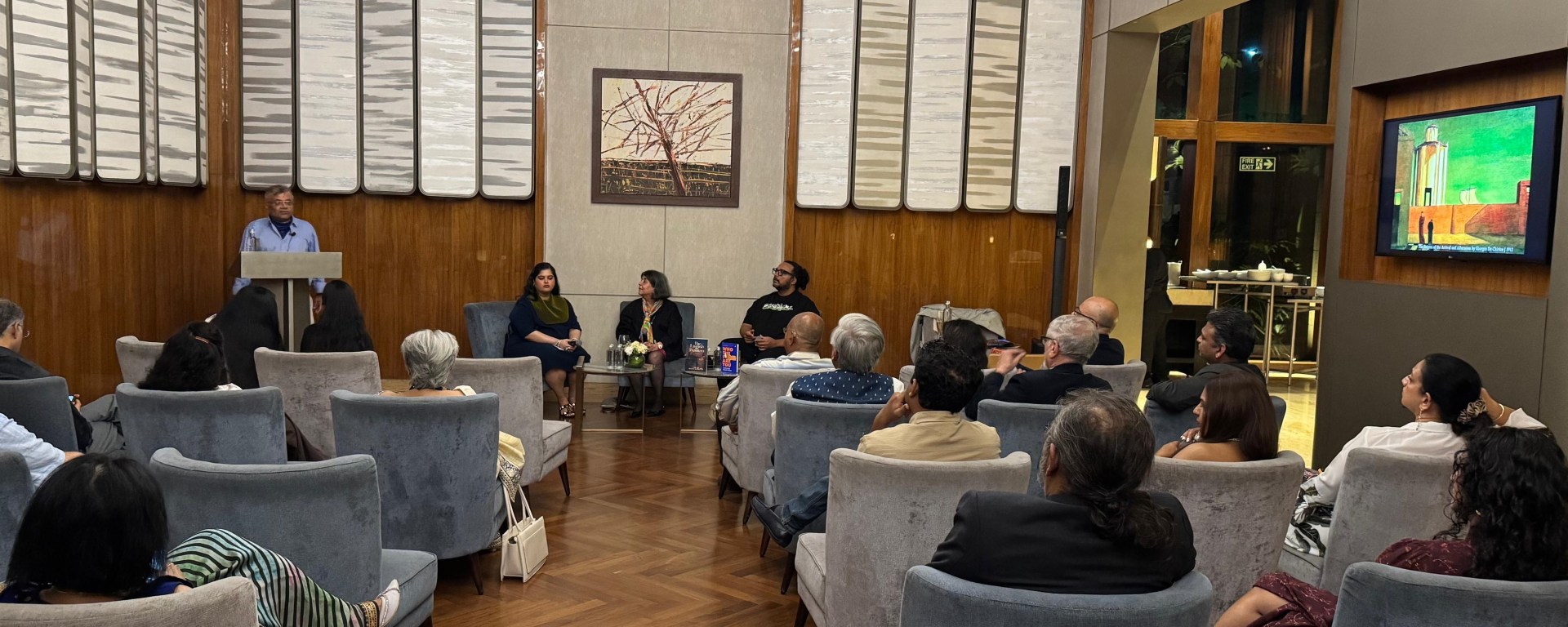
‘The English Problem’ is a newly published book authored by Beena Kamlani. Published by Bombay Circle Press, it was launched in the city of Bengaluru at a recent literary event at the Hotel Den, located in Whitefield. The event was graciously hosted by Mr. Vinesh Gupta, the General Manager of the Hotel Den. The book launch took the form of a panel discussion featuring the author, Beena Kamlani; the publisher, Aakriti Patni, who also served as the moderator; and a speaker, Harinder Singh Pelia. The literary evening began with an introductory speech or exposition by Dr. Kaustav Bhattacharyya.
Please find below the EXCERPTS FROM THE SPEECH BY DR. KAUSTAV BHATTACHARYYA DISCUSSING THE BOOK AND ITS THEMES.
Good evening! Namaskara! Suswagatham! A very warm welcome to you, ladies and gentlemen, to this very special edition of Literary Conversations at the Hotel Den: the launch of the book, ‘The English Problem’, authored by Beena Kamlani and published by the Bombay Circle Press. I must mention that many thanks are due to Aakriti Patni, Founder of the Bombay Circle Press and one of the partners, whose brainchild this Bengaluru book launch was and who is the driving spirit behind this literary evening.
I wish to proclaim here with great pleasure that Aakriti belongs to my alma mater, City University of London. Unfortunately, Aakriti studied at the University’s Department of Journalism/Media Studies—the more literary, intellectual part of the University—and I studied at the more pragmatic, practical Bayes Business School. Hence, during our early stages of interaction, we decided that I would be the ‘hardcore’, ‘numbers’ part of the venture and Aakriti would bring in the aesthetics, intellectualism, or cultural flair. But pretty soon, Aakriti realized that I am totally hopeless with numbers. I promised then, when she asked me if I was good at anything, that I could organize good social gatherings like this literary evening, having studied Social Sciences for my doctorate. Although even here, all credit is due to Mr. Vinesh Gupta, General Manager of Hotel Den.


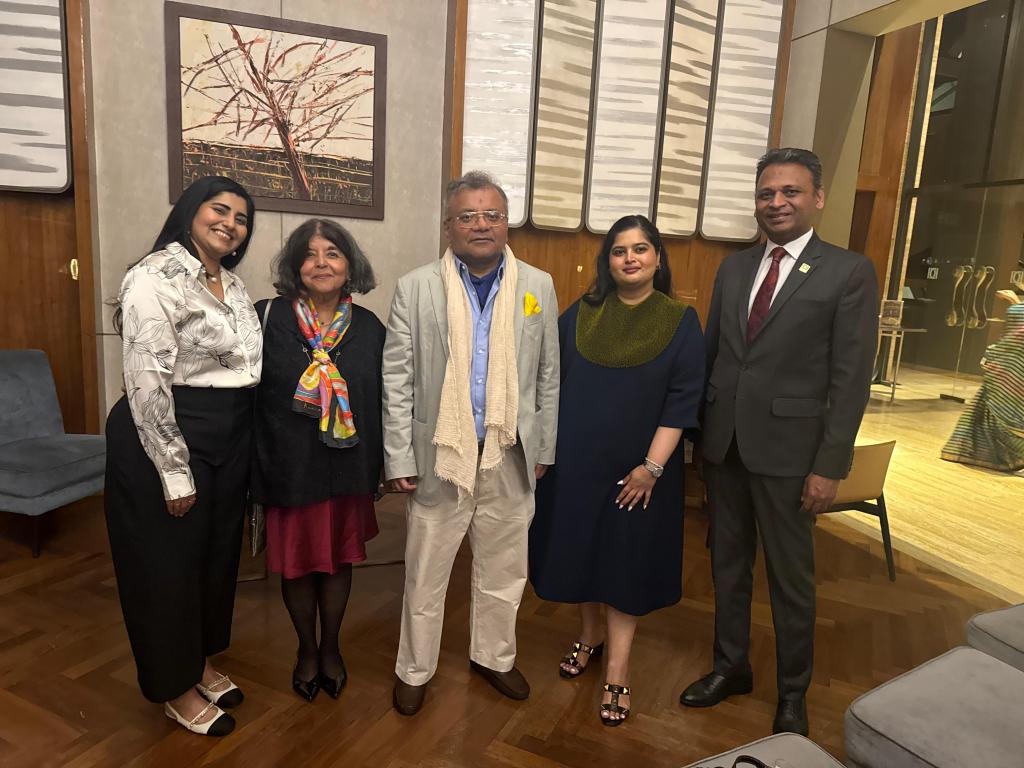
Thanks a lot, Vinesh, for hosting us and organizing this literary evening so meticulously.
Finally, I ended up with the promise of being the proverbial ‘Shakespearean caricature’ where I will introduce the book and the themes, make a fool of myself, and leave the more serious intellectual elements to our fantastic panel!
Regarding the book ‘The English Problem’, I wish to quote Arthur Schopenhauer, the German philosopher, who in an essay speaks about the two kinds of authors: those who write for the subject’s sake and those who write for the writing’s sake. And clearly, here, Beena belongs squarely to the first kind. Schopenhauer goes on to write: ‘It is only the author who writes absolutely for the sake of the subject that writes anything worth writing.’ I would humbly add: worth reading!
Now, what exactly is the subject here? It is the story of an 18-year-old, Shiv Advani, who embarks on a voyage to the UK to study Law to qualify as a Barrister. Shiv is one of the ‘selected few’ by the venerable Mahatma Gandhi, with the promise to return to assume leadership in an independent India while participating in the process of the Freedom Movement. The book focuses on, or describes, his experiences and encounters with an Empire—in this case, the British Empire—an alien civilization, racism, prejudices, the idiosyncrasies of the Elites or Upper Classes, joys, trials, tribulations, and delightful encounters. He then returns to India in a tragic state after being shot at a seminar where he was speaking, accompanied by a Scottish nurse. Shiv stays at the Pollack family residence, and Beena Kamlani captures the significant following Mahatma Gandhi enjoyed amongst the educated classes or intellectuals in Britain, many of whom expressed empathy and solidarity with the cause of India’s freedom from British rule.
Beena Kamlani, the author, writes with felicity, passion, richness of sentiment, and sincerity rarely found, which makes the book an engrossing, educational, illuminating, and, yes, most certainly enjoyable read. Please do pick up a copy; I highly recommend it.
Now, I will touch upon the broad themes which I discerned for this presentation.
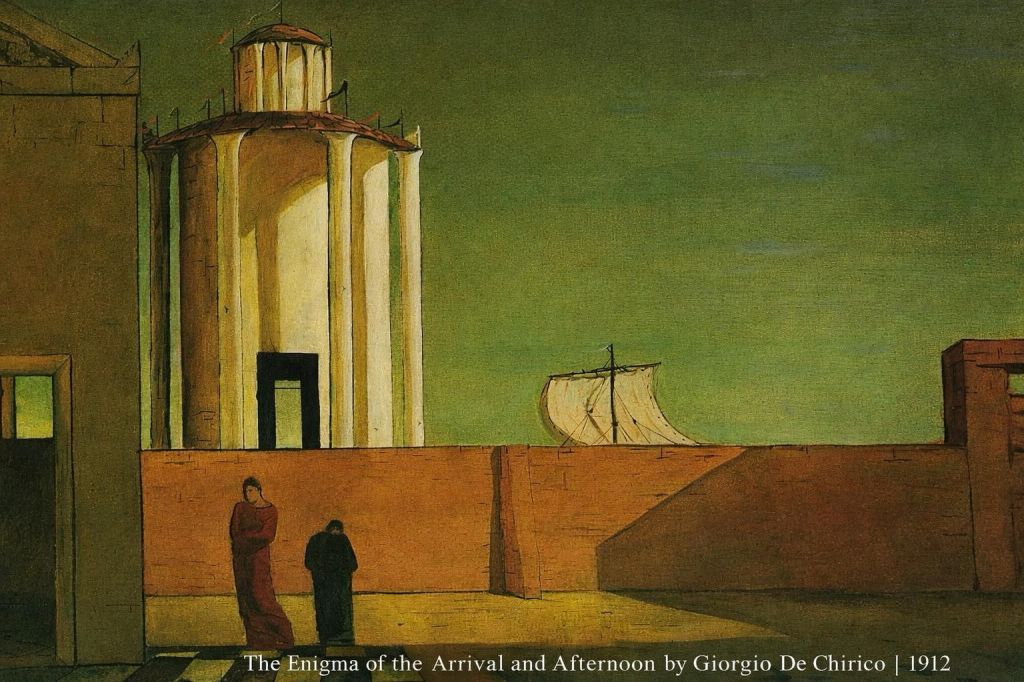
Firstly, I would request all of you to turn towards this painting on the large screen, titled ‘The Enigma of Arrival’ by the Italian metaphysical painter Giorgio de Chirico from 1912. It is the cover of a rather famous book by a Nobel laureate author. Any guesses?
It is V.S. Naipaul and his eponymous novel, inspired by the painting, titled ‘The Enigma of Arrival’.
While reading this book, a deep chord was struck in me by the ‘thematic specter’ of the novel, and more so of the painting, with which it corroborates more closely than the novel (though the book is similar to the current one in terms of plot and narrative):
- ARRIVAL
- DISPLACEMENT
- ENCOUNTER
- ENTRANCE
- BELONGING/ATTACHMENT to the new PORT or LOCATION
According to the novelist Ian Mackenzie, ‘That painting provides the inspiration for a not-quite-novel-within-the-novel—one the nameless first-person narrator dwells on but never writes.’
A few words about the painting:
- CLASSICAL LANDSCAPE
- SURREAL
- MEDITERRANEAN SCENE of an Ancient Roman Port City
We have here in the painting the following structural elements:
- A TALL TOWER
- A WHARF IN THE BACKGROUND
- BEYOND WALLS AND GATEWAYS, the TOP of the MAST of an ANTIQUE VESSEL
- Two human figures or individuals on a checkered floor
- One, perhaps the person who has just arrived in the Port—the ARRIVISTE—Shiv.
- The other, perhaps the native of the Port (Lucy or the Pollack family).
In this notion of ‘Arrival’ or ‘Odyssey’, one is conditioned by our growing-up years, and there are unexpected twists and turns in this ‘Voyage’ into the Distant/Unknown, which is warmly and succinctly captured by Beena Kamlani.
There were moments in this book when these quotes from V.S. Naipaul lingered in my mind, striking a deep note:
‘The antique ship is gone.’
‘Gradually there would come to him a feeling that he was getting nowhere; he would lose his ‘sense of mission’—he would begin to know only that he was lost.’
This was often evident or manifest in the book where Shiv, while being cognizant or aware of his responsibilities and commitments back home to his father, family, and the Guru Mahatma Gandhi, would saunter into territories of fun and frolicking, which is quite humane and natural for a student in a distant land.
The next pertinent theme, or even the leitmotif, of the book is the notion of Empire—British in this case—and Colonialism, with Shiv being a ‘colonial’ subject from India which is ruled by the British, the proverbial British Raj. Then, upon his arrival in London, which is the Imperial Capital, he encounters the ‘Imperium’—the forces or currents of Imperialism most often manifested as Racism and Prejudice. Interestingly, I wish to broaden or widen the notion of Empire as articulated by Beena Kamlani to that of the ‘METROPOLE’ and ‘PERIPHERY’, where India is the periphery with London as the Center/Citadel of this Metropole. The Metropole is the center of power, endowed with all sorts of Capital and Resources including Cultural Power, and there is an asymmetrical relationship of power and influence between the Metropole and Periphery. This is an idea developed and proposed by Harold Innis, the Canadian theorist.
In many ways, we have similar encounters or arrivals with respect to other global Empires and Colonial Powers. As a matter of fact, we could have multiple books titled ‘French Problem’ or the ‘Vienna Problem’, since both Paris and Vienna were the Capitals of global Empires: the French and the Habsburg/Austro-Hungarian.
Let’s face the fact that modern-day Empires exist where METROPOLES have disproportionate or asymmetrical power and influence over the PERIPHERY in terms of CAPITAL, TECHNOLOGY, GEOPOLITICAL POWER, and CULTURAL SOFT POWER. Contemporary prime examples here are the GLOBAL FINANCIAL EMPIRE with Wall Street as the Metropole, and the GLOBAL BIG-TECH EMPIRE with Silicon Valley as the Metropole.
Today, we have large metropolitan centers of power of Capital and Culture like New York, San Francisco, Los Angeles, and the proverbial Silicon Valley acting as Imperial Capitals along the lines of London and Paris of the early 20th century. Modern-day business schools like Harvard and Wharton, and big-tech universities like Stanford, inspire and evoke similar awe, admiration, and mystique as the erstwhile Inns of Court, or for that matter, the old ideas of dreaming spires and lawns of Oxford and Cambridge. Sartorial influences—the casual wear of T-shirts and jeans or pullovers—would be as powerful in terms of impact, with students eager to emulate them, as it was with the old-fashioned gowns. Can we deny that a contemporary Indian student will be mesmerized by the setting of these big-tech universities and business schools, just as Shiv Advani was in his day by the Inns of Court and the Barristers? This is the Charm of Power and its seductive appeal.
Vienna was a Center of Learning for the Habsburgs Empire, which strategically imparted knowledge to the subjects from the fringes of the Empire as a mission, to sustain and develop the Habsburg/Austro-Hungarian Empire. Staying with the early pre-World War II notions of Empire: in the French context, there was a term for colonial subjects being sent to Paris to study Law, Sciences, and Humanities from the colonies of Africa to understand, absorb the French ideals, and develop admiration. This was BRASSAGE.
BRASSAGE was the mixing and mingling of students from France and different parts of the French colonies, especially Africa, where social, cultural, and educational integration was intended between the French and African students to foster a ‘GREATER FRANCE’. It was desired to create a Shared Cultural Identity, similar to what British barristers encouraged in Shiv: that he would run India once the British departed.
Again, in a similar vein to Shiv Advani, the African students experienced Racism and Prejudices, and many started getting drawn towards anti-colonial, independence movements. For example, in a 1956 Editorial in the FEANF journal, ‘L’Etudiant d’Afrique Noire’, R. Mawlawe` writes, ‘Logic, truth, justice – we have been taught that these are quintessentially French qualities. Why, when we avail ourselves of them, do you find us anti-French? A surprising truth’ – similar to the claims of Indian Freedom Fighters demanding the quintessentially British qualities of Freedom and Equality.
Similarly, many students in Vienna went on to become founding and crucial members of new states, forging new ideologies and movements, some of which challenged the hegemony of the Habsburg Empire.
On a striking, dramatic, final thunderous note (remember, caricature) and the theatrical role, I wish to end with a Shakespearean quote about ruminations, since a lot of the book and writing are about that.
Here we go:
From AS YOU LIKE IT, ACT IV, SCENE I
I have neither the scholar’s melancholy, which is emulation; nor the musician’s, which is fantastical; nor the courtier’s, which is proud; nor the soldier’s, which is ambitious; nor the lawyer’s, which is politic; nor the lady’s, which is nice; nor the lover’s, which is all these; but it is a melancholy of mine own, compounded of many simples, extracted from many objects, and, indeed, the sundry contemplation of my travels; in which my often rumination wraps me in a most humorous sadness.”
Thank you, ladies and gentlemen, for your attention! Have a splendid evening!
 COUNTRY SQUIRE INDIA