

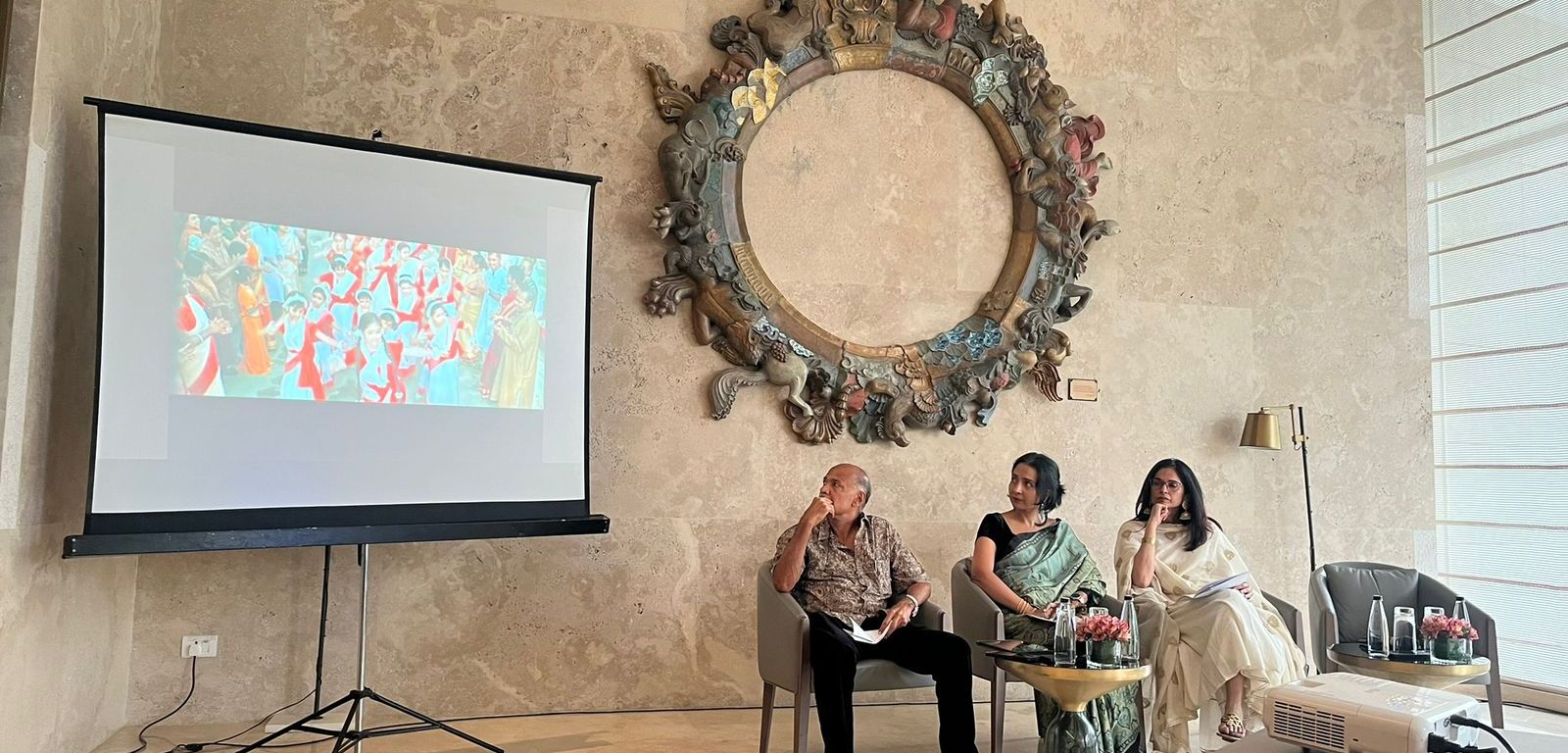
Recently, a gathering of literary and intellectually inclined individuals in Bengaluru convened at the luxurious Four Seasons Hotel to celebrate the literary and cultural legacy of India’s Poet Laureate, Gurudev Rabindranath Tagore, on his 164th birth anniversary. The event took place on the warm, sunny afternoon of May 10, 2025.


The distinguished panel of speakers included:
- Captain Gopinath, India’s aviation pioneer, founder of the first private airline, and a passionate cultural philanthropist.
- Dr. Sujata Kelkar Shetty, life coach, award-winning author, resilience trainer, and clinical scientist, holding a PhD and post-doctoral credentials from the prestigious NIH, USA.
- Dr. Madhavi Peters, social entrepreneur, policy analyst, and lawyer, educated at the elite Johns Hopkins University, USA.
- Mr. Ashish Sen, theater personality, author, community media practitioner, and writer, educated at the renowned University of Cambridge, UK.
Dr. Kaustav Bhattacharyya, columnist for Country Squire Magazine (Indian Edition), delivered the introductory address to the esteemed audience. Below is an excerpt from his speech, along with links to the songs performed at the event.
Good evening! Namaskara! Swagatam!
A very warm welcome to you all, ladies and gentlemen, to this special literary afternoon conversation celebrating the birth anniversary of Gurudev Rabindranath Tagore!
Gurudev Rabindranath Tagore—India’s poet laureate, its first Nobel Prize winner in Literature—was a versatile genius. His creative talent and acumen were vast and diverse, encompassing short stories, fiction, poetry, songs, art, philosophy, and political thought—practically every facet of human expression.
Hence, I have always felt a sense of diffidence and awe when participating in or hosting any discussion on Gurudev’s literary legacy. However, a Bengali TV program titled ‘Amader Rabindranath’, curated and hosted by the writer and intellectual Ranjan Bandyopadhyay, came to my rescue as a source of inspiration. This afternoon’s literary conversation is largely modeled after Ranjanbabu’s program, where he invited eminent personalities—such as filmmaker Aparna Sen, actress-musician Mamata Shankar, and director Rituparno Ghosh—to share how Tagore inspired them on a deeply personal level. Rather than an academic discourse, the focus was on their intimate connections with his vast body of work.
I found this approach far more fascinating than traditional literary analysis. Today, we have a distinguished panel who will share their personal inspirations drawn from Gurudev’s works—their own individualized interpretations of his legacy.
On a personal note, I am delighted that all our panelists have been my fellow travelers in literary and cultural pursuits. Dr. Sujata Shetty once graciously allowed me to interview her for an article, while Mr. Ashish Sen endured the ordeal of interviewing me for a book. Yet, despite that excruciating experience, they have kindly agreed to join us today. I must admit—interviewing me was far more painful than being interviewed, as one must relive the encounter while transcribing! So, my deepest sympathies lie with Ashishda. Thank you both!
My hero and champion, Captain Gopinath, has been a steadfast supporter of my literary endeavors. In fact, he graced my last Tagore-themed conversation exactly two years ago, illuminating it with his insights. It feels like déjà vu! Thank you, Captain!
I am also grateful to Dr. Madhavi Peters, who brings tremendous energy and enthusiasm to today’s panel. She previously participated in a conversation on German philosophy and now takes on the role of moderator. Thank you, Madhavi!
In my last program on Gurudev, I attempted to moderate but ended up being so menacing that I received job offers as a prime-time TV anchor! (Apparently, intimidation is a prerequisite for the role.) I even requested Captain Gopinath to consider me if he ever launches a TV channel. This time, I wisely handed the reins to Madhavi. Thank you again!
Now, I’d like to introduce Gurudev Tagore through two soulful Rabindrasangeet pieces, written and composed by him.
The first, ‘Amar Je Sob Ditey Hobey’ (broadly translated as “All That I Must Give, O Lord”), belongs to the ‘Puja Parjaay’ section of ‘Geetimalya’. This is a song of renunciation—a meditation on returning the gifts bestowed upon us by the Divine Spirit. It speaks of transience, gratitude, and service to humanity—a theme deeply relevant to our panel:
Captain Gopinath, who embodies philanthropy in arts and culture.
Dr. Sujata Shetty, whose work in mental coaching and self-development uplifts countless lives.
Dr. Madhavi Peters, who left a comfortable career to support Himalayan farmers.
Ashishda, a Cambridge graduate who has mentored generations in theater and the arts.
The ‘Puja Parjaay’ collection reflects Tagore’s philosophy: The Divine is not confined to rituals but is a guiding force in every moment of life. For him, music was a profound medium to connect with this presence.
The second song, ‘Hey Nutan’, is a gentle, uplifting birthday tribute—composed for Tagore’s last birthday celebration on May 6, 1941, at Shantiniketan. Adapted from his poem ‘Pochishe Boishak’ (his birthday in the Bengali calendar), it welcomes a new dawn with hope, set in Raag Bhairavi. Ironically, Tagore was initially reluctant to compose a song for his own birthday but was persuaded by his disciples.
Both songs are from Bengali films, with the second clip depicting a typical Rabindra Jayanti celebration.
Thank you, ladies and gentlemen, for your attention! Without further ado, I now hand over the stage to Dr. Madhavi Peters. Wishing you all a splendid and enriching evening!
Song Links:
BACKGROUND OF THE SONGS PLAYED:
FIRST SONG – AMAR JE SOB DITE HOBEY:
The song belongs to the ‘Puja Parjaay’ section of the collection of songs known as ‘Geetimalya’.
This is a beautiful song of renunciation of all the gifts bestowed on us by the DIVINE SPIRIT/FORCE or the SUPREME BEING thus it is about RECONCILIATION of our life, giving back what we received. The song reminds us of our transient existence and at the same time celebrates the gifts and wealth bestowed on us by the DIVINE SPIRIT/FORCE or the SUPREME BEING thus exalting the SPIRIT OF SERVICE to humanity.
SECOND SONG – HEY NUTAN
Hey Nutan’ is a sweet, genteel, nice enriching Birthday song for Gurudev Tagore written and composed by Gurudev himself. As a matter of fact this was sung on his last Birthday celebration of his life held on May 6th, 1941 at Shanthiniketan. The song is recomposed from a poem, ‘Pochische Boishak’(25th day of the Bengali month of Boishak which happens to be Gurudev Tagore’s birthday) from his book, ‘Purabi’, and one of the last songs written by Gurudev himself. The song is set in Raag Bhairavi welcoming the new dawn, prays for the auspicious moment of birth to return like that of the Sun which rises every day displacing all the morning haze and mist. ‘Hey Nutan’ celebrates Tagore’s love for life, it gives a message of a strong hope that human life will flourish. Funnily the anecdote goes that Gurudev was reluctant to compose a song for his own Birthday but was persuaded by his friends, students and disciples. Both the song clips are drawn from Bengali movies and the setting for the second one is a typical Rabindra Jayanti celebration in Bengal.
2.0 TAGORE’S PHILOSOPHY IN FIRST SONG:
A few words about the ‘PUJA PARJAAY’ collection of songs would be pertinent here: Here in this collection Gurudev Tagore evokes his philosophy that the SUPREME BEING or DIVINE FORCE/SPIRIT is not a separate distinct entity or figure in our lives only to be thought of or celebrated during worships, prayers or rituals but to be thought of and revered and venerated as GUIDING FORCE in every moment of our lives, every action we are engaged in. For Gurudev Tagore songs or music is one powerful way or means for feeling and connecting with the manifestation of the DIVINE FORCE/SPIRIT. It’s through songs and music that Gurudev Tagore celebrates the All-Pervading presence of the SUPREME BEING or DIVINE FORCE/SPIRIT.
 COUNTRY SQUIRE INDIA