


BY RUCHIRA GHOSH
Kaushiki Deb grew up surrounded by dozens of musically devoted uncles and aunts—a testament to the sprawling extended families typical of India. One of her fondest childhood memories is singing in the dark with relatives until the power returned.
Though her father was a doctor, and she was expected to follow in his footsteps, young Kaushiki was drawn irresistibly to vocal music. Her maternal aunt became her inspiration, while her mother—her first tutor—not only sang but also played the guitar. Later, she trained under Ghanshyam Dutt of the Kirana Gharana (classical) and Rina Ghosh (a disciple of the late Maya Sen and Ritu Guha) for Rabindra Sangeet.
An alumna of Patha Bhavan, a premier Kolkata institution, Kaushiki recalls how Tagore’s music permeated her schooling, leaving a lasting imprint. She then pursued a Bachelor’s in Pharmacy at Jadavpur University, followed by a five-year stint in R&D at Reckitt & Colman, Kolkata. Like many women of her generation, she married a mechanical engineer, moved to Delhi, and devoted herself to raising her children—a period that temporarily disconnected her from music.
It wasn’t until her children were older that she rekindled her passion. The pandemic became an unexpected catalyst, prompting her to participate in online musical collaborations with friends and acquaintances.



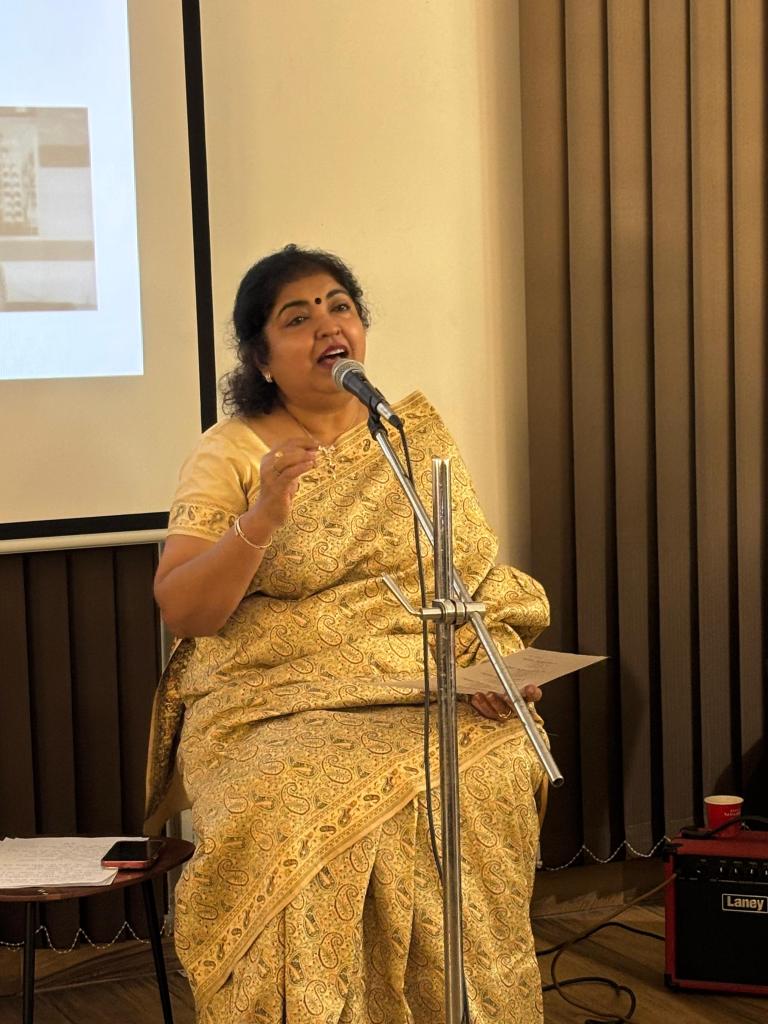


Her musical tastes are refreshingly eclectic, spanning legends like the late Rashid Khan, Shubha Mudgal, and Pandit Bhimsen Joshi to international icons like Donna Summer and Lionel Richie, as well as contemporary artists like Aditi Mohsin. Among her notable performances are recitals at Kolkata’s Rabindra Sadan, Rotary Club, and the Federation of Film Societies of India. In Delhi’s theatre and music circles, she is a familiar presence—most recently lending her voice to Taslima Nasreen’s Lajja in a stage adaptation late last year.
On Guru-Shishya Parampara
“I believe we should adhere to it as much as possible,” Kaushiki asserts. “Core training in classical music demands a strong mentor-disciple bond, as music is a gurumukhi vidya (knowledge flowing from the guru’s mouth)—yet it also relies deeply on shruti (one’s listening ability).”
On Fusion and Modern Influences
“There has always been an influx of external styles into Indian music, and composers have historically embraced it positively,” she reflects. “This cross-pollination has enriched our traditions—but it must be handled carefully to preserve the original essence.” After a pause, she adds, “When blending two Indian genres or fusing Indian with foreign styles, one must tread wisely and possess deep knowledge of both. Experimentation is welcome, but never at the cost of dilution.”
The Future of Vocal Music in India
“India’s musical diversity is its strength,” she says. “Every genre is rich with heritage, and every community cherishes music. As long as audiences appreciate mastery, the future of vocal music in India is radiant.”
A Message to Budding Singers
“I urge the next generation to prioritize devotion and practice over self-promotion,” she advises. “The greatest reward comes from within. Yet, amid today’s competitiveness, many young artists chase visibility over artistry. I hope they strive to preserve India’s musical traditions in their purest form.”
 COUNTRY SQUIRE INDIA