


BY CSM STAFF WRITER
A Cup Of Tea & Madeleine Cakes With Kris: CSM’S Proustian Afternoon
For our debut CSM India Edition conversation, we engaged with a biological scientist trained at the highest level of global research—the citadel of science, the National Institutes of Health (NIH) in the USA.
Our guest for afternoon tea at the Four Seasons Hotel was Dr. Sujata Kelkar Shetty, who explores the role of immune biomolecules in stress-related disorders. As someone who once struggled with biological sciences during my rudimentary school years, the prospect of this conversation was initially daunting. However, I managed to dispel my schoolboy academic anxieties by extolling the virtues of organic tea and the delicious Madeleine cakes, with their Proustian charm.
As we settled in—ordering Orange Blossom tea, Indian fried vadas (savory donuts), and desserts for Sujata, while I indulged in Madeleine cakes—I asked about her interest in biological sciences. Sujata credited her father’s strong influence, as he believed the future lay in science. A dutiful daughter, she followed his guidance.
But why biological sciences? Sujata explained that life fascinates her—she loves people, animals, and trees. A deep desire to nurture life, an intrinsic “mother energy,” drives her.
Between bites and sips of our first cuppa, the conversation turned to her academic days in the US, which she poetically described as “sweat, blood, and tears.” Recalling her PhD years as “very, very hard work,” she spoke with pride about the grueling hours spent on meticulous lab experiments. She thrived under the mentorship of Dr. Swati and Shirish Barve, who taught her “more than words can describe.”
With a sigh of relief, she moved on to her undergrad days—a liberating experience that shattered the real and imagined shackles of her sheltered upbringing.
Interestingly, the pinnacle of her academic journey—her postdoc at the NIH—was filled with fun and enjoyment, a “remarkable and very international experience.” She likened the NIH to “the Silicon Valley of medical research,” buzzing with innovation and global collaboration. She fondly recalled the NIH cafeteria, where scientists from around the world bonded over eclectic interests—concert pianists, archaeology enthusiasts, and in her case, Indian classical music.
Seizing the opportunity, I steered the conversation toward her passion for Indian classical music. Trained since age seven in singing and Kathak dance, she studied under luminaries like Savita Devi, Jawad Ali Khan (grandson of Bade Ghulam Ali Khan), and now Shanthi Kumar Jain, a businessman-turned-musician.
Next, I broached the theme of India and the Anglosphere in science. Sujata noted the significant presence of Indian scientists in US and UK research institutions, fostering fruitful collaborations.
By our second cuppa, I turned to her fascinating transition from highbrow scientist to a champion of public wellness. With sparkling passion, Sujata shared her lifelong goal: applying scientific knowledge for the common good. Returning to India for family, she raised children while running “The Frangipani Club,” a book club for young mothers. Engaging with people and reading popular medical literature ignited her desire to bring research to the masses. She has since written nearly 100 columns on mind, body, and health, including her Mint series, “Wellness Sutra.”
Her newest avatar? A certified life coach, trained at the Coaching Training Institute (CTI). During the pandemic, she became a resilience trainer, helping organizations build strength.
Over our final pot of piping-hot tea, served in exquisite bone china, I asked Sujata to envision the future—both societal wellness and her role. She sees adolescent health as an underexplored frontier in India, requiring a “curated” healthcare model blending pediatric and adult practices. She’s optimistic about millennials and Gen Z, who she believes prioritize wellness more than any previous generation.
When I quipped Bernard Shaw’s line—“He who can, does; he who cannot, teaches”—Sujata lit up: “Exactly! I want to do more, not just advise.” Her ambition? A “tangible, brick-and-mortar” venture with real-world impact, particularly in women’s health—a blend of benevolence and enterprise.
Chastened by my literary pretensions, I invited her for more conversations, warning they’d come with my “eccentric cuppa sessions.”
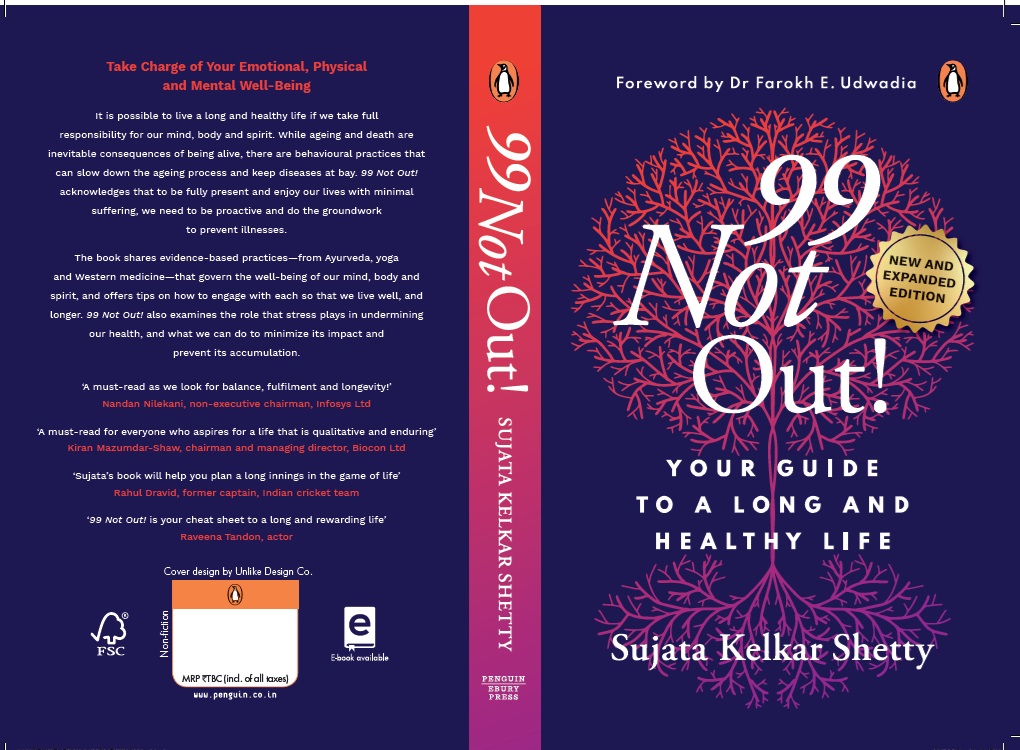
On her horizon? More books—her upcoming teen mental health guide (August release) follows her popular “99 Not Out! Your Guide to a Long and Healthy Life.”
We then delved into her rootedness in Indian tradition, despite her global upbringing. For four years, she taught the Bhagavad Gita to children through stories, making its wisdom accessible.
As we neared the end, I broached her privileged background—daughter of renowned economist Dr. Vijay Kelkar, with uncles in the army and cardiac surgery. Sujata acknowledged the “lottery of birth” with grace, explaining how her work in wellness aligns with her family’s ethos of service. Her mother, a child psychologist, further inspired this path.
Closing, Sujata thanked me for a “funny, engaging, genteel, and gentle chat.” Her kind words left me satisfied that my scientific inadequacies hadn’t hindered our lofty exchange.
As we parted, I recalled Thomas Jefferson’s notion of a “natural aristocracy”—those with “virtue and wisdom enough to manage society’s concerns.” Sujata embodies this ideal: a scientist of top-tier intellect who chose public wellness over prestige, blending wisdom and virtue for the greater good.
 COUNTRY SQUIRE INDIA