


BY DR KAUSTAV BHATTACHARYYA
Good evening! Namaskara, ladies and gentlemen. Thank you very much, Sanjay, for the kind introduction, and a warm thanks to the entire Whitefield Sheraton team and Sonia, the Marketing Communications Manager.
I am absolutely delighted this evening to introduce the theme of this literary program with Dr. Aseem Shrivastava as the Guest Speaker. His Himalayan retreat in the majestic silence of the hills has been interrupted for this session. I hope he will remember it fondly as the ‘Himalayan Bonanza’ or ‘Himalayan Splendour’! Thank you, Aseem.


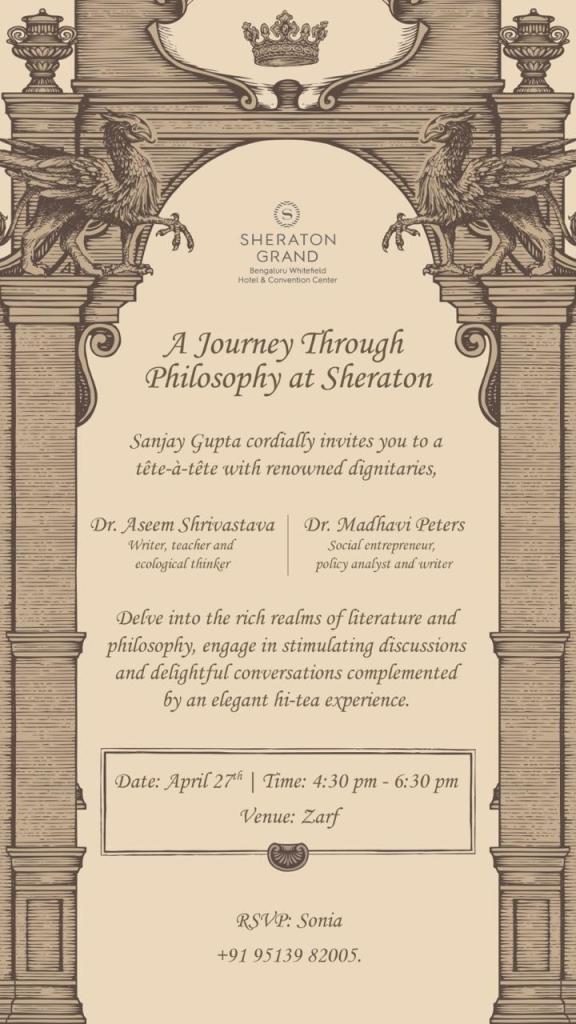

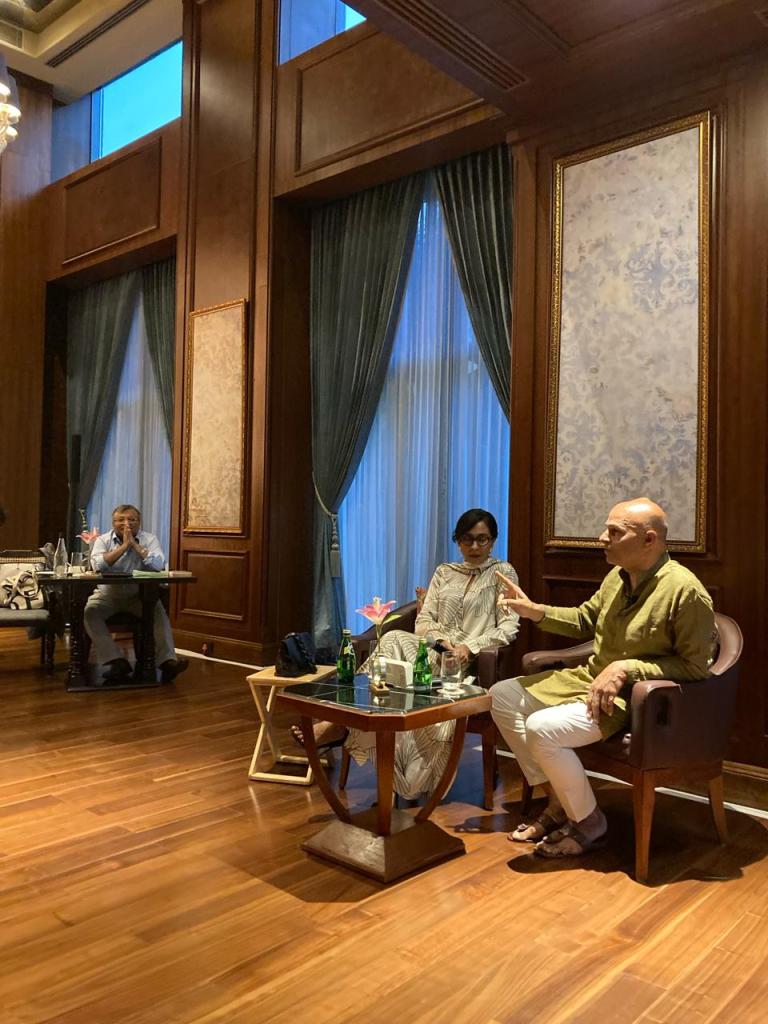
Joining us this evening is Dr. Madhavi Peters, who must possess enormous Nietzschean ‘Will to Power’ to agree to a session with me given the bombardment of my abstract philosophical ideas. I met Madhavi at someone’s 90th Birthday party earlier this year, and after a few minutes of conversation, she jokingly remarked to her husband, who is here tonight, that ‘very soon I would be celebrating my 90th if I keep speaking with this chap.’ Thank you, Madhavi, for your courage.
The term ‘Nietzschean’ here implies ideas connected with Friedrich Nietzsche, the German philosopher. John F. Kennedy, the late US President, once held a dinner at the White House for intellectuals, scientists, Nobel laureates, and writers, which included the likes of JD Salinger. He remarked, “I think this is the most extraordinary collection of talent, of human knowledge, that has ever been gathered together at the White House, with the possible exception of when Thomas Jefferson dined alone.” Tonight, we have such a distinguished eclectic gathering, along with fine speakers like Madhavi Peters, but with the possible exception of when Aseem Shrivastava is the Guest Speaker.
Aseem embodies the very best of the modern Indian intellectual tradition and the distinct culture of sophisticated Indian aesthetics. My tryst with philosophy began during my youth, whiling away time at libraries or rummaging through bookstores and British Council libraries. Here was my first encounter with serious philosophy and philosophers: Friedrich Nietzsche and his magnum opus ‘Beyond Good and Evil’. Around the same time, I bought Plato’s ‘Republic’ and ‘Symposium’, which, as I recently learned, are favorites of Madhavi’s.
Plato and Nietzsche were my early ‘waltzing’ partners in philosophy. During those years, one just had to dabble in philosophy to belong to intellectual circles. Just as Nietzsche described his perfect reader, I always picture a monster of courage and curiosity, born adventurer and discoverer.
‘Philosophos’ according to Plato is a disinterested seeker after wisdom and Knowledge. ‘Virtue is knowledge’ is the motto for Plato, where knowledge is the ruling element in life. Hence, tonight’s theme of a personal journey with philosophy is difficult to narrow down to specific texts or possessing a doctoral degree. It’s more of a lifelong journey akin to a river with its bends and gorges.
As Bertrand Russell wrote, ‘Science is what we know, and philosophy is what we don’t know.’ As Nietzsche put it, ‘Philosophy as I have so far understood and lived it means living voluntarily among ice and high mountains—seeking out everything strange and questionable in existence’.
Where does this illumination through philosophy happen? Well, it’s in solitary walks, in traffic jams, in cafés and bars, in conversations between living minds. Philosophy requires dynamic give-and-take between people, known in Plato’s terms as ‘Dialogues’. What should philosophy do for you? According to Nietzsche, it uplifts our mind, spirit, and body.
Plato’s dialogues ‘Protagoras’ and ‘Meno’ deal with the acquisition of virtue, whether it can be taught. Both end with the response that one can’t answer this question since one doesn’t yet know what virtue is.
Plato’s philosophy has a certain mystique, leaving an enduring impression on the mind. Plato’s appeal lies in the Dialogues, offering insight into philosophical debates and unfolding of ideas.
In conclusion, as Shakespeare said, “Take him and cut him out in little stars, and he will make the face of heaven so fine that all the world will be in love with night.” As I conclude, if I have lacked clarity in my thought, let me cite Protagoras: ‘There are many hindrances to knowledge: the obscurity of the subject and the brevity of human life.’ And with Wittgenstein’s aphorism, ‘What can be said at all can be said clearly, and whereof one cannot speak, thereof one must be silent.’
Thank you, ladies and gentlemen, and wish you a splendid evening!
 COUNTRY SQUIRE INDIA