

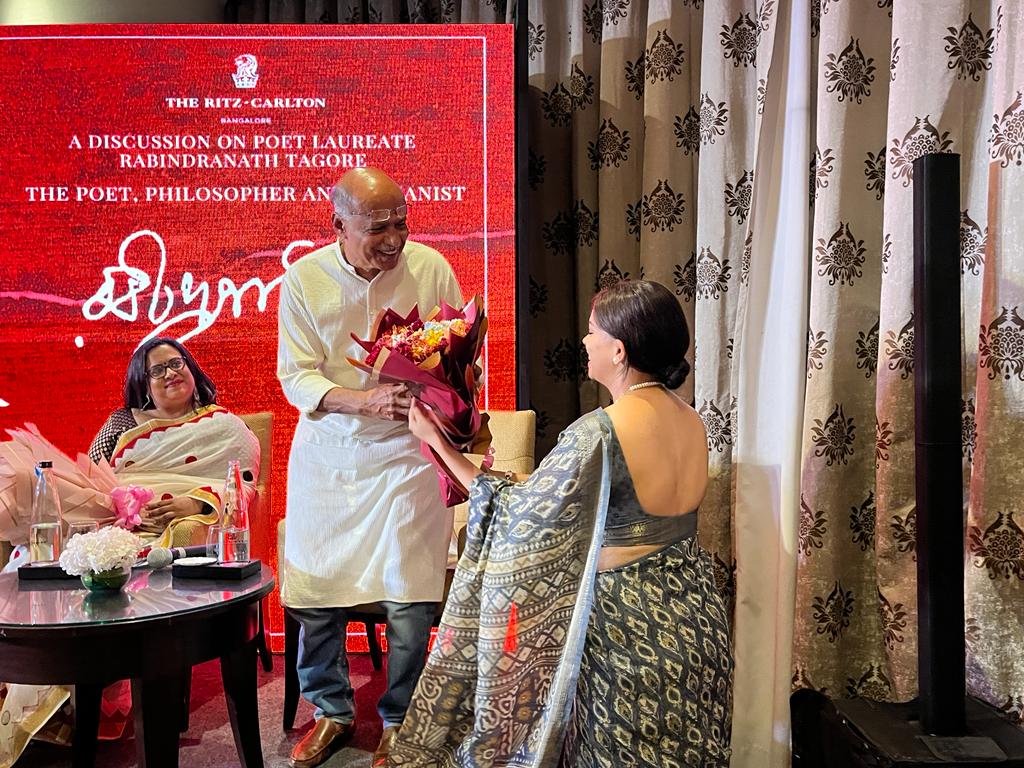

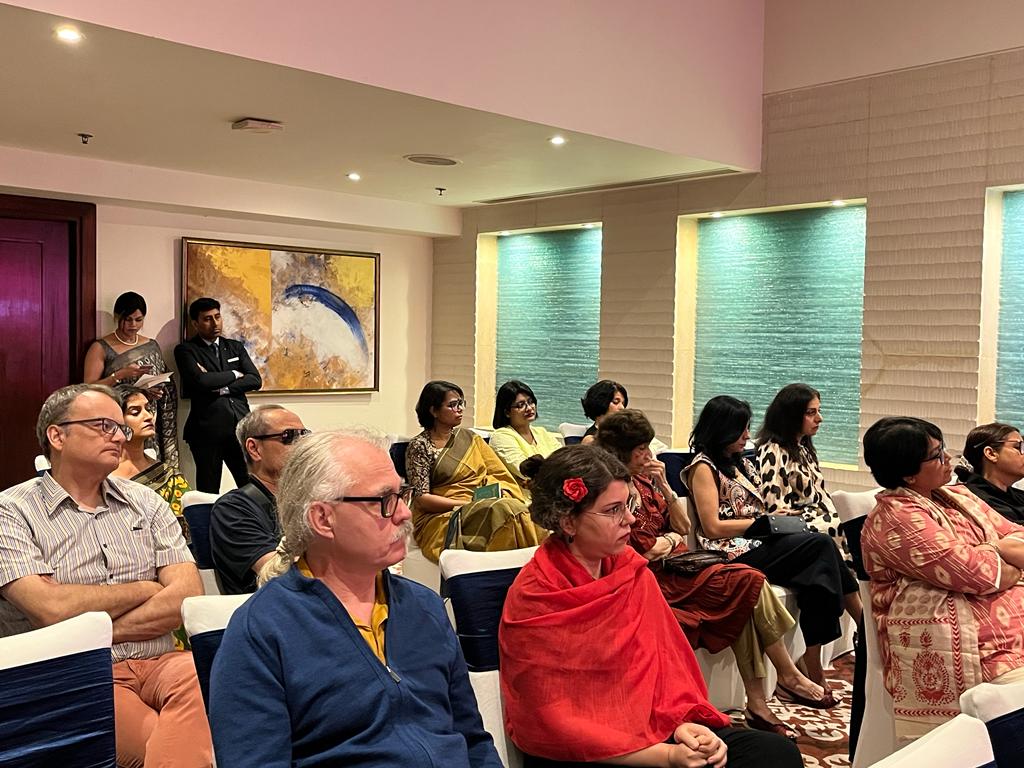
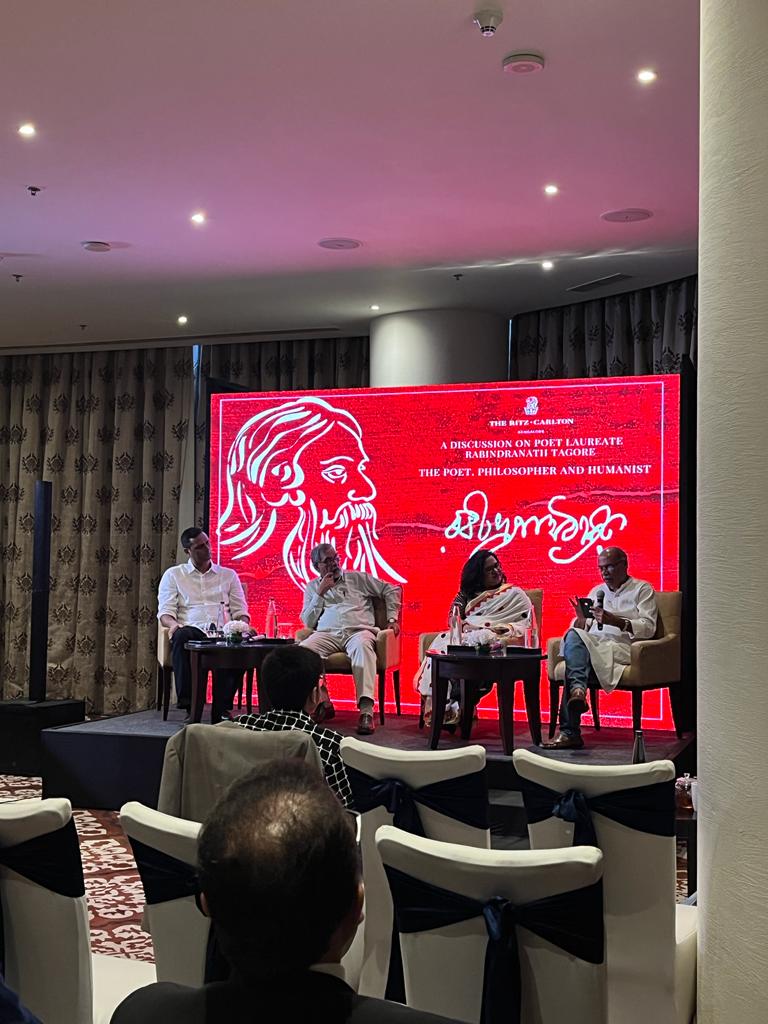
The city of Bengaluru witnesses a very special Cultural Evening event on the 27th May whose theme was something very dear to most of our hearts, about the Poet Laureate Gurudev Rabindranath Tagore and exploring his oeuvre through his Poetry, Philosophy and his role as an Universal Humanist and was titled ‘A Discussion on Poet Laureate Rabindranath Tagore: The Poet, Philosopher and Humanist’.
The stage was adorned by an eclectic group of speakers with the founding father of modern Indian private aviation Captain Gopinath, the ingenious creative techie turned artist Sayanti Dutta, the scholarly articulate Sociologist academic Dr. Chandan Gowda and the Sustainability Technology Policy global guru Lawrence Surendra.
Aiding them and keeping time peppered with wit and humour was the ubiquitous cultural amateur researcher with love of aesthetics yours truly, the author of this column. The discussion content touched upon on serious issues of rampant urbanization, rising tide of nationalism, notions of universal humanity and the influence on works of art of the delectable Tagore poetry.
Here I wish to pen few thoughts, reflections settling down after hearing the event about the theme of Tagore as a Poet and how I connect and interact with his poetry through his songs Rabindrasangeet.
POETRY – BLOSSOMS THROUGH TAGORE’S SONGS:
The fullest blossoming of Tagore’s poetry for me is manifest is his songs popularly known as ‘Rabindrasangeet’ with its poignant, evocative and melodious touch which is a feast for our inner soul. Rabindrasangeet is a vast repertoire of 2000-odd songs with a metaphysical thread celebrating often our spiritual quest, yearning for the Union with the Supreme Being, natural landscape and our varied emotions encountered through this journey of life. As Poet Laureate Rabindranath Tagore mentions in his own words, ‘Thousands of songs, an ocean of songs – not too many notice that aspect, I have flooded the land of Bengal with songs, You can forget me, but how can you forget my songs.’ Ananda Lal, scholar-musician defines Rabindransangeet as ‘unbridled, phenomenal, creativity’.
The musicologist, Arnold Blake defined Tagore’s skilful craft as the ‘delicate moulding of single, unaccompanied melodical line in which the emotional overtones of his poem found expression.’ For me I found the apt description of the appeal of Rabindrasangeet in what Professor Philippe Stern of l’Ecole du Louvre had to say, ‘vital significance of Tagore’s song is the inseparable union of rhythmical language: verse and music.’ The globalization of Rabindrasangeet happened with Arthur Geddes and Arnold Bake, two European musicians who developed a collection with Western notations.
Poetry in its essence must strike at our depths of heart and soul with emotions of joy, ecstasy, longing, sadness, nostalgia, pain or yearning for a higher self; the emotions need not always be one of happiness or delight since life throws lots of undesired pain at us. Poetry is a means or tool for us to experience and process and distil these emotions enabling us to come to terms with the vagaries of this mortal life, and it’s precisely here that for me Tagore songs played such a pivotal role in my life. My life experiences in distant lands were made palatable and sensible through hearing the tunes and absorbing the words of a Rabindrasangeet number. The songs are much more striking for the words and their meanings rather than the tunes which are very beautiful indeed, but it’s the hypnotic effect of the words which endure in our minds and hearts.
As we are aware that Poet Laureate Rabindranath Tagore drew his musical tunes or the composition from very diverse sources across the globe; Indian Classical genres like Hindusthani, Carnatic, Western Classical, Scottish hymns, and the folk music of Bengal. American composer Craig Hella-Johnson wrote this of Tagore: “All of the verse he writes is so beautifully shaped that it feels like it is already music simply when read aloud. I decided to follow the contour of his lines and wrote what I called ‘modern plainsong chant’ as to give his words the most space to express their own shapely essence.”
As a matter of fact the collection of poems, ‘Gitanjali’ which won Poet Laureate Rabindranath Tagore the Nobel Prize in Literature in 1913 has been the source of a large number of his songs hence the title in English, “Song Offerings”.
Practically all of the songs, Rabindrasangeet are written and sung in Bengali and have become a cornerstone of Bengali culture, and according to Pabitra Sarkar, ‘If anyone questions us what is the finest harvest of Bengal’s culture, our unhesitant answer is, Rabindranath’s songs.’ A key compendium or collection of Tagore songs, Rabindrasangeet is the ‘Gitabitan’ consisting of nearly 2300 poems which have been composed into songs.
The entire collection is divided broadly into 6 categories of Puja(worship), Prem(love),Prakriti (seasons), Swadesh (patriotism), Aanushthanik (occasion-specific), Bichitro (miscellaneous) and Nrityonatya (dance dramas and lyrical plays). This compendium of poems inspiring songs of Rabindrasangeet is now a treasured book and part of our golden collection in our homes and libraries.
I ventured forth to explore the source of this emotional richness or this evocative appeal in Rabindrasangeet and stumbled realized a lot of it emanates from Indian tradition which Tagore delved into as an inheritance and inspiration like that of our devotional music, spiritual and folk music of the ‘Baul’ variety from Bengal; ‘Bauls’ are minstrel-bards. The idiom of a yearning for romantic love permeates the lyrics of these traditional Indian musical renditions. As one of the commentators remarked in case of Tagore songs, ‘The singer has everything within him. The notes come our from his very life…’
Rabindrasangeet has this unique ability to touch the depths of our heart and evoke perceptible palpable emotions by tuning into our inner musical strings or chords which is intrinsic to every human being. The song has a strong visual appeal in our imagination where our mind can see the reality being unfolded through its words and tunes. It’s time to establish my point through a song played at the event, Ekla Chalo Re (translated as Walk Alone) which was published as a poem in the ‘Bhandar’ magazine in 1905 and then the musical tune and rendition was imparted by Indira Devi, niece of Tagore and it was initially part of the anthology of ‘Baul’ which was inspired by Bengali folk songs and poetry. The song is a clarion call for individuals who have embarked on a mission or journey to pursue and persist despite all the hurdles, discouragement and lack of empathy.
This is an exhortation or most of us mere mortals to pursue vigorously our dreams and aspirations which are part of a nobler mission. The key lines of the song broadly translated into English is: ‘If one beckons or responds to your call then walk alone, walk alone.’ The visual appeal of this song when played in its strong intense melodious tune with force is enormous and truly impacts our mind. Perhaps I guess this is precisely why this song was the favourite of Mahatma Gandhi and legend has it that Gandhiji sang this song when he met Poet Laureate Tagore for the first time in his abode Shanthiniketan in Bengal and mentioned how this song inspired his freedom struggle march.
As I embarked on exploring the philosopher and Humanist angle of Poet Laureate Rabindranath Tagore I feel just too overwhelmed by a maudlin sentimentalism and an ennui with the human cognitive rational discourses which lead us nowhere!! I leave my readers with few moments of lingering ponderous sentimentalism about the trivialities of our mortal existence and lets indulge in the celebration of our nature and existence on this planet!!!
I shall leave you with these lines below:
Ever in my heart have I sought thee with my songs
It was they who led me from door to door
And with them have I felt about me
Searching and touching my world



 COUNTRY SQUIRE INDIA