

BY ANDREW LOBO
Mimi was the eldest daughter of the Wargdar of Falnir. Her charming mother, Mersu Bai (born Emerciana, née Noronha), had siblings that included Magdalena, wife of Pfx Saldanha; Monica, ancestress of the distinguished Gonsalves clan; and Monsignor W. Noronha, who studied at the papal seminary in Kandy. Mersu Bai was a benefactress of the Church, and her remains are interred in the central aisle beneath the main altar of Milagres Church in Mangalore. J.M. Mascarenhas’ daughters were the brilliant Nellie, homely Dolly, beautiful Pulcheria (who became a nun), clever Clotie, and simple Prissy.
Mimi’s father adored her; she mattered more to him than all his nine other children combined. As a precocious three-year-old, he would stand her on the circular marble table at his glorious home, Sunnyside, and she would recite lines from “Casabianca” (“The boy stood on the burning deck, when all but he had fled”). Mimi educated me in culture—she was deeply conscious of her lineage, being a direct descendant of the three Wargdars of South Canara. Her paternal grandmother, Anna Maria, was the only daughter of the Wargdar of Thonse; and in turn, the latter’s Saldanha mother was the only daughter of the Wargdar of Omzoor. Mimi tolerated no insolence.
Her beautifully appointed home featured rosewood furniture that had won the 1935 Colonial Exhibition award, Louis Seize silver, Persian and Turkish rugs, parchment dating from the time of William the Conqueror, and—last but not least—her own oil paintings. Her dinner menus included asparagus, artichokes, and soufflé. Her world was Eurocentric. Her Swiss maid, Ida from Geneva, accompanied her to England; and in London, she lived at the exclusive Art Deco St. Mary Abbots Court in Kensington and attended Mass at the Brompton Oratory, where Queen Ena of Spain also worshipped.
Her persona complemented that of my distinguished grandfather, Albin, a senior imperial government servant. I have place settings from state banquets where she was seated next to a Maharaja (of Bharatpur) and just two places away from the Viceroy (Lord Linlithgow). Her baggage label marked “State Room,” from her last sea voyage returning to Bombay in 1937, ensured that she dined at the captain’s table.
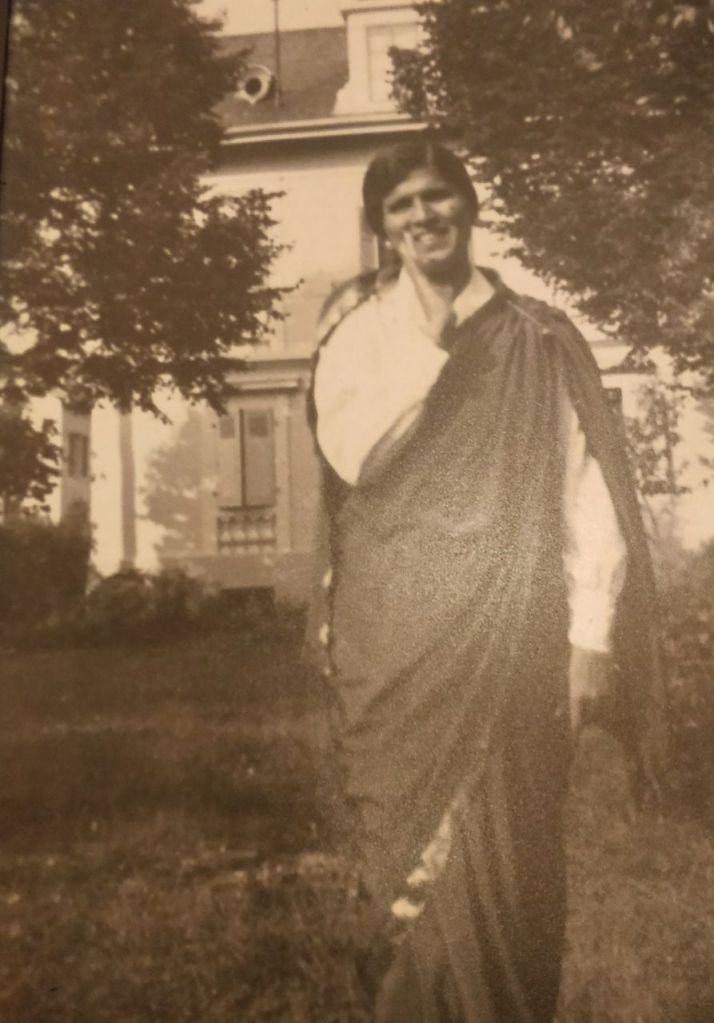
My grandfather graduated in economics from St. Xavier’s College, Bombay, where he was taught, among others, by Sir Homi Mody and Father Prince Lowenstein, S.J., a relative of the Habsburg Emperor Franz Josef. His college friend, Monsignor D’Silva, was later posted with the Curia in Rome and arranged for Mimi—dressed in a black sari with a gold border and a long-necked, long-sleeved cream blouse—to have private audiences with two Popes, Benedict and Pius, during the period when they styled themselves as prisoners in the Vatican (from the 1871 unification of Italy under the House of Savoy until the Lateran Concordat of 1929).
A notable figure among my grandparents’ circle of friends was Archbishop George Saupine, S.J., the very personification of simplicity—he wore a wooden cross on a thread and a simple copper ring. He hailed from the Azamgarh zamindari, and his aunts were Lady Hasan Imam and Lady Ali Imam. When Mimi made a grand entrance, she inspired awe.
At the inauguration of St. John’s Medical College, I sat next to her in the front row. Cardinal Gracias’ mother was at the Karachi home of Mimi’s stylish friend, Francesca Demello, mother of Anthony, of B.D. Crick control, and endowed the Gol Dakshina Cathedral in Delhi.
Andrew Lobo is based in Bengaluru
 COUNTRY SQUIRE INDIA