

BY RUCHIRA GHOSH
One winter afternoon a few weeks ago, I visited an art exhibition in Delhi. The highlight of this grand show was its dedication to young artists: painters and sculptors who were fresh graduates, master’s degree holders, interns, apprentices, and even a few exceptionally talented youths struggling to find their footing in the realm of Fine Arts.
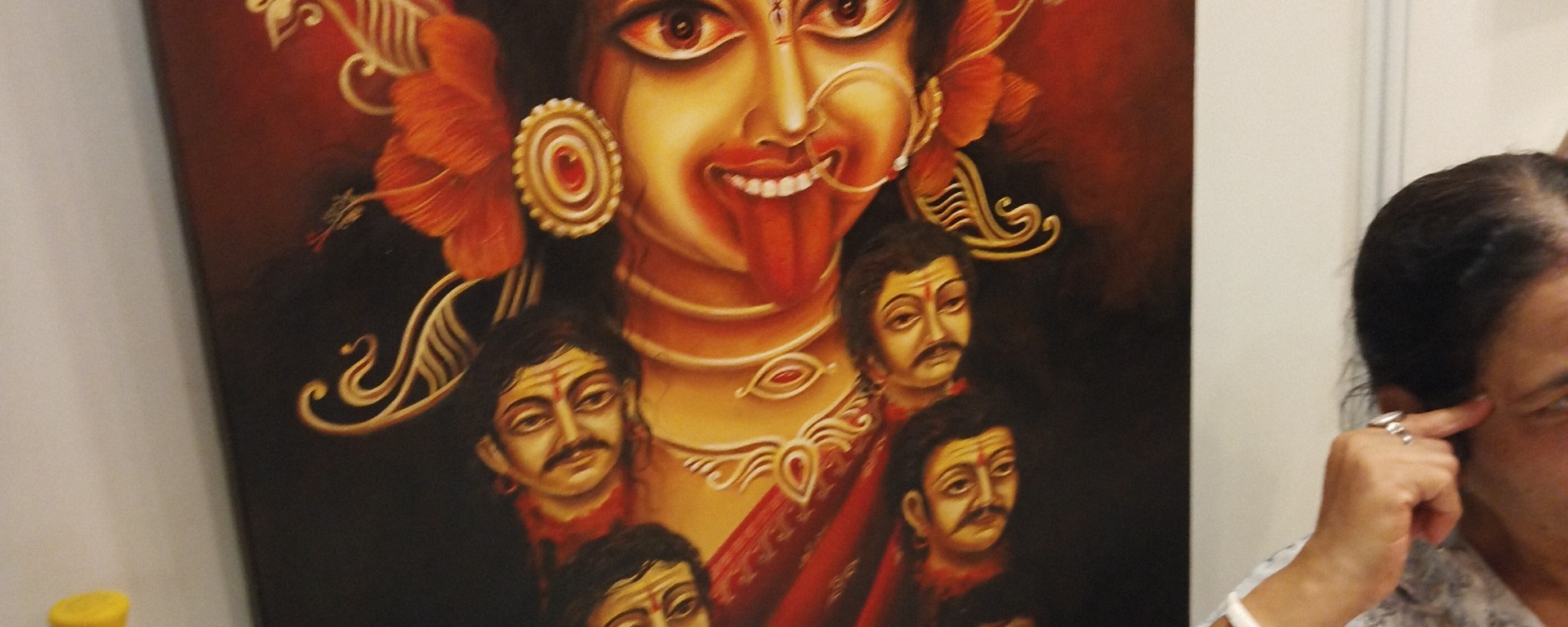
As I ambled through the stalls, one particular display caught my attention. The portraits showcased were predominantly—if not exclusively—focused on the fierce and awe-inspiring Hindu deity Maa Kali, in her myriad moods and manifestations. There were, of course, a few images of the genial, pot-bellied Lord Ganesha, known as the harbinger of good luck, success, and prosperity. I was somewhat surprised by this choice of subject matter, which seemed unusual given the vast pantheon of Hindu faith and mythology.
While I stood before the stall, contemplating the artwork, a lanky, shy young man in his twenties approached me. He introduced himself as Tushar Chanda, a true blue Dilliwallah (as they say in Hindi). Soon, we began discussing his work, and his answers were crisp and down-to-earth. Tushar described an ordinary childhood, typical of an educated, urban upper-middle-class family. Although he was interested in the sciences from a young age, his parents encouraged him to become a well-rounded individual—what is colloquially called a “jack of all trades.” Consequently, he was often taken to participate in singing, elocution, recitation, and on-the-spot drawing competitions. “That’s how I developed a taste for multiple arts,” he quipped.
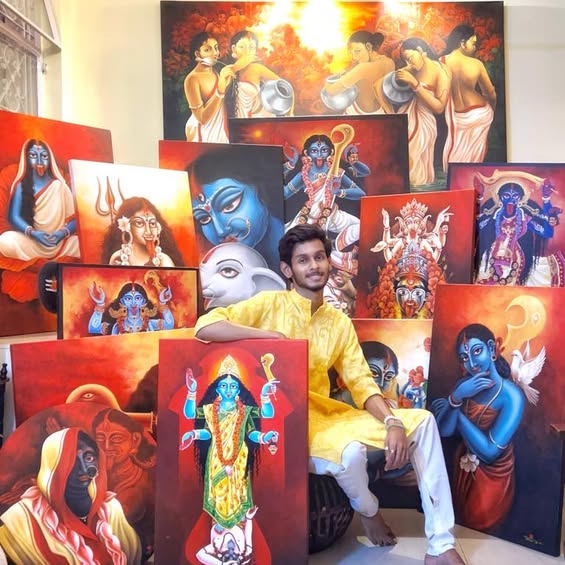
Then destiny intervened. Despite securing excellent grades in high school, he managed to escape the mounting pressure to pursue science and gained admission to the prestigious Delhi College of Art.
I asked him about his fascination with a female deity. Tushar replied, “You see, in our Bengali community, many grand festivals are filled with images and figurines of goddesses; they became part of my everyday life. Additionally, before the festival season, I would visit the mini Kumortuli in Delhi’s Bengali neighborhood, Chittaranjan Park, where artisans and potters craft beautiful clay images of deities. I was taken aback to see stark nude representations—some holding a trishul (trident), others with unruly dark tresses—in various stages of formation. One image, in particular, depicted a nude woman with wild hair and a lolling tongue standing atop her supine, motionless spouse. Although I was too young to understand the significance, it fascinated me.”
It might sound a tad uncanny, but Tushar claims his bond with the dark deity began while he was still in his mother’s womb. His mother had gone to pray at a famous Kali shrine in Kolkata, which shocked those around her since it is (erroneously) believed that the deity could be ominous and malevolent for an unborn child… However, nothing of the sort happened; on the contrary, he has nurtured a fascination for Maa Kali since childhood and continues to do so.
Our conversation veered to the topic of gurus, mentors, and his sources of inspiration. “I am not attached to any particular guru or teacher, per se. My inner quest for Art and Beauty helps me seek inspiration from everything that surrounds me. Whatever interests or attracts me, I strive to imbibe it.”
“What are your views on spirituality?” I asked curiously.
He said, “It’s many things, actually… My ideas about faith and belief are not exactly inspirational; rather, I would call it experimental spiritualism. Rather than being a divine entity to be feared, held in awe, and worshipped, I am constantly aware of the divine mother’s presence all around me—in my house, my studio, my sitting room. Her benign presence pervades everything. Believe it or not, at times she is the girl next door; at other times, she is like my own biological mother, loving and caring. My very being, my entire existence, revolves around her.”
For Tushar, so besotted with art, who are his favourite painters? “Well, there are so many who have inspired me. Let me stress that I appreciate and admire realistic works of art. I draw inspiration from the oeuvres of Raja Ravi Varma and Vrindavan Das, who is almost synonymous with ISKCON. Then we have the brilliant female painter Vijaya Sagar; one must not forget the Mexican painter Omar Ortiz, whose forte is realism and the nude form.”
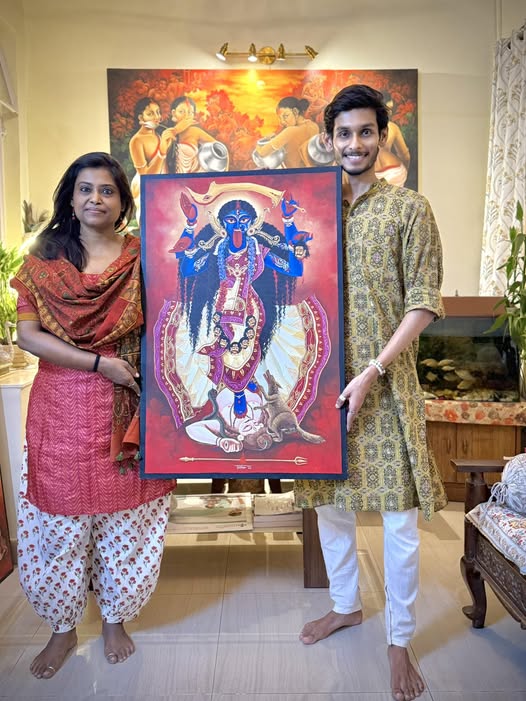
Speaking of his moments of pride, Tushar recounted how, during their countrywide “Pankh” live concert tour, the celebrity duo Kaushiki Chakraborty and Santanu Moitra had profusely praised one of his paintings at the New Delhi event. “On another occasion, a few years ago, the CR Park Kali Mandir authorities commissioned me to paint a portrait of Maa Kali. To this day, it is displayed prominently in the temple’s office. This is a signal honour for me, as the shrine attracts numerous visitors, both devotees and laypeople. I am truly thankful to them,” he concluded.
“What are your future plans?” I posed as my final question.
Pat came the reply: “No concrete plans as such; I aspire to elevate my work to a level where I can earn a good living and smooth out the struggles that most newcomers undergo.” He added after a pause, “Ultimately, it is the divine will that will prevail in my life. Therefore, I have surrendered myself to Maa Kali. I will humbly go wherever she leads me…”
 COUNTRY SQUIRE INDIA