

BY RUCHIRA GHOSH
“If music be the food of love, play on…” Shakespeare wrote aeons ago. The ultimate truth of human life.
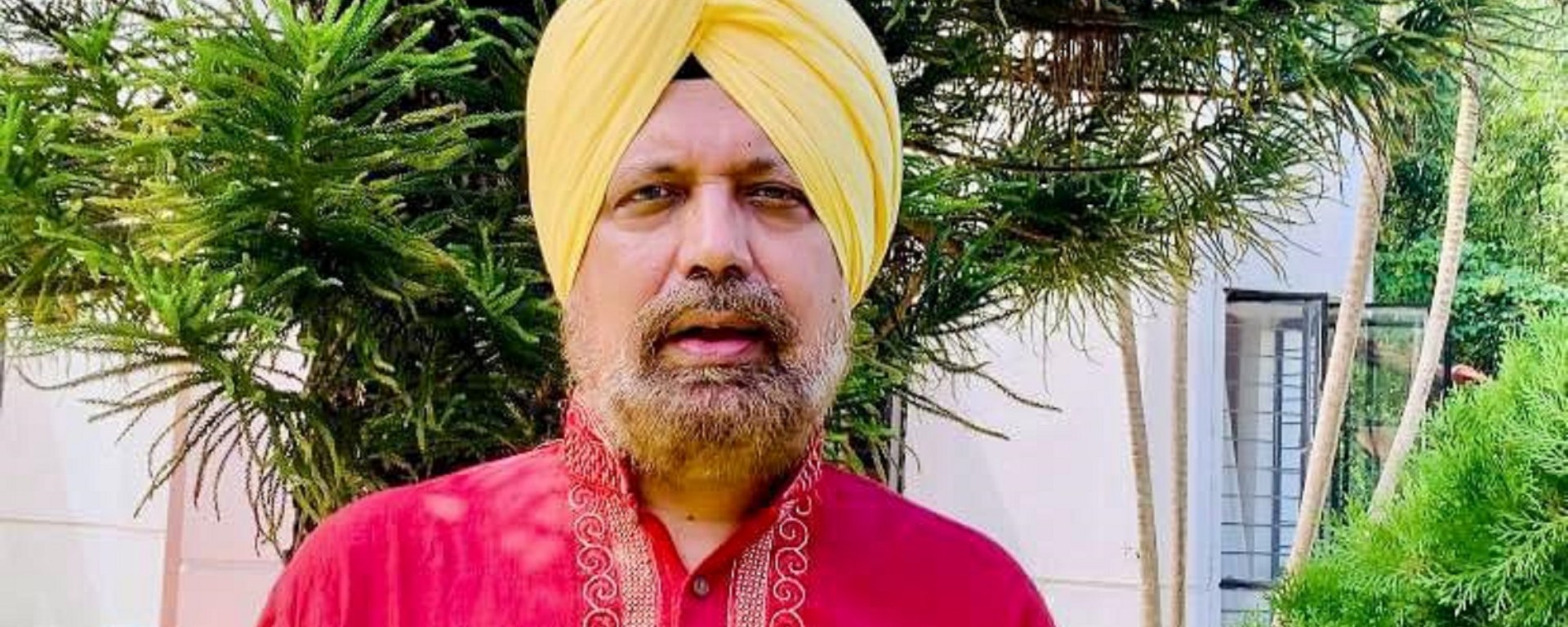
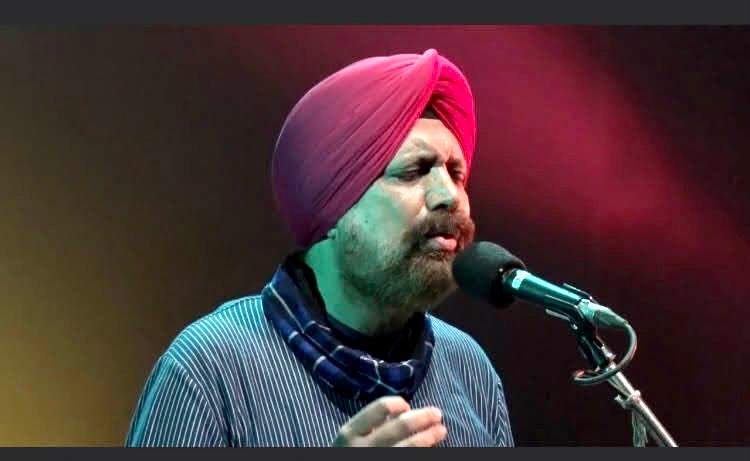
Apparently Param Kalyan Singh, popular Kolkata-based crooner upholds this thought in letter and spirit. The genial, affable Sardarji’s passionate romance with Rabindra Sangeet /Tagore’s Songs began nearly fifteen years ago. A proverbial late bloomer Singh has done rather well for himself. Significantly he prefers to live in Kolkata, where all the “action” (Tagore’s music and culture) is. So when Param Kalyan is not enjoying his platter of Sarson da Saag &Makki di roti or working in his upmarket office on Chittajrajan Avenue, he’ s most likely busy studying or practicing his favourite music. Sounds interesting? Please read on:
Please tell us about your early life, family background schooling, higher education, siblings etc.
I was born in Punjab. I completed my schooling in Taraori a small town in the Karnal district of Haryana. It is an old town dating back to the era of Prithviraj Chouhan the 12th century monarch. My grandfather served there as Deputy Collector and choose to settle in Taraori post-retirement. I did my B.Com from Dyal Singh College Karnal. I did a two years Sikh Missionary course to garner complete knowledge about Sikhism. In addition, did a Computer Proficiency course way back in 1991 from NIIT to be in sync with the changing times. I have a younger brother who lives in Delhi with his family. I earn my living as a marketing consultant and I live alone in my apartment located in south Kolkata.
Q. Since you nurture such a passion for music it’s obvious there was music in the family. Was there?
You would be surprised but there was absolutely no musical background whatsoever in our family. No one in my previous generations was into music.
Q. Please describe your musical journey, how and when did you begin your training?
I began my formal music journey rather late. Not until 2012 when I was 46 years old. I remember singing in school in Saturday class 1 a couple of times. I think it was “Kabhi Kabhi mere dil mei khyal aata hai”which was a hit those days. Later during a visit to my mom’s sister’s home (again in Punjab) I sang before a few of her neighbours. They quite liked it, not because I had a great voice or anything but because I sang with emotion. I also liked to listen to Western pop and Hindustani Classical music, vocal and instrumental both. I would buy a wide range of audio cassettes from Rajan and Sajan Mishra to Titans of Western Classical namely Mozart and Beethoven.
Do you know Guru Granth Sahib the sacred scripture of the Sikhs contains 1430 pages? On them are inscribed numerous Gurbani shabads ( hymns) which have been classified under 31 main raagas of Hindustani classical music. Way back in 1991 A gurbani singer / raagi had remarked that every Sikh must learn at least one Raag. Greatly inspired I made up my mind to learn one Raag at least. But I could achieve this only in 2012.
You see I lived in Kolkata for work from 1987 to 2004. I picked up the Bengali language and managed to speak albeit with a slight accent. At this juncture I heard of Rabindra Nath Tagore and managed to memorise a solitary line of the song “jodi tor dak shune keho na ase”.
Owing to circumstances I relocated to Ludhiana and subsequently to Delhi where I lived until 2012.
While in Delhi I joined the music school of Smt Madhumita Acharya Biswas. Interestingly, she teaches classical and semi-classical music to kids and adults alike.The first Raag I learnt was Yaman Kalyan. One day while listening to a bandish based on this raag sung by Rashid Ali Khan on YouTube “eri aali piya bin” I suddenly discovered its similarity with Tagore’s lyrics “dariye achho tumi amar”. The melody and the words appealed to me so much (not that I understood each word) that I asked Guruji to teach me this song. She replied that to learn the song I would need to consult the standardized notations (swaralipi), set by Tagore himself. I was so keen that I got someone to courier me the volume forthwith. Having practiced all by myself, one day I sang before my guru. Obviously impressed, she motivated me to participate in the music competition to be held at a local Durga Puja conducted by a private association later that year. Can you believe I won great applause from the audience who very kindly glossed over my not-so-accurate pronunciation (since I was an alien to the language) and other technical glitches as I was still a novice? I won the 3rd prize. Since then, I have never looked back. Gradually I found myself enchanted, nay intoxicated by Rabindra Sangeet. I started learning new songs one by one. The journey continues and I shall remain eternally grateful to my first mentor/guru Smt Madhumita Acharya Biswas for inspiring and encouraging me. She is the one who made this journey possible.

Q. Tell us about your gurus in all genres of music
After my stint with Smt Madhumita Acharya Biswas, I took to learning Dhrupad from Sh Prashant Mullick a doyen of the Darbhanga gharana. Subsequently I learned Dhrupad under the tutelage of Pandit Nirmalya Dey. He greatly impacted my life and I still practice basics just the way he taught me. Later, after I had shifted back to Kolkata nine years ago, a friend of mine took me to Smt Anita Pal at Rabitirtha. She is a distinguished pupil of the legendary Smt Suchitra Mitra. It was she who taught me the nuances viz sur /melody, taal/rhythm, bhav/emotion and ucharan/pronunciation in depth. I still send her my song recordings and she checks out the errors.
I was also tutored by Carnatic singer Sh Satyanarayana Asok. He taught me the famous “Lavanya Rama” originally written and composed by the renowned Saint Tyagraja. Interestingly Rabindranath composed “Eki Labonye purno pran ” based on this song ” I also learned Dhrupad from another maestro the Late Sh Ramakant Gundecha. I must mention that I had also enrolled in elementary classical music classes conducted by Sh Mohan Singh Khangura who is a prominent faculty member of Vishwa Bharati university. Since I was also keen to learn Western classical I managed to buy a piano and currently, I am attending online piano classes conducted by the well-known tutor Robin Hall.
Q. How many decades old is your romance with Bangla and Rabindra Sangeet??
Well, I picked up Bangla conversation during my previous stint in Kolkata. I was always fascinated by Satyajit Ray’s films and have seen all of them. Now after I got interested in Rabindra Sangeet, I started learning Bangla more seriously to read and understand lyrics and notations. During my second and ongoing stint in Kolkata, I began learning Bengali more intensively. I can read Bengali and write it too (via keyboard though). I dabble in poetry and short story writing. I do some serious reading of Bengali books regularly.
Q. After so many years what is Tagore to you in terms of emotions and sentiments not forgetting mundane daily life as well?
Tagore is part of me now. Always on mind 24×7. Singing, listening, trying, reading while commuting, at work, during walks or chilling at home. I enjoy living in spiritual communion with my two mentors i.e., Guru Nanak and Rabindra Nath.
Q. Which categories of Tagore’s songs are your favorites/ inspire you.
There are no fixed categories as such. I have drawn up a list of songs which I plan to learn in addition to what I have already learnt. This list gets updated regularly as I keep learning new songs. Some new songs I like so much that they overtake my previous list.
Q. Like most North Indians you could have opted for Indi pop semi -classical, film music, Hindustani classical…why this choice of Bangla language and music since the culture is strikingly different from yours. What are the hurdles you faced?
When you love something then hurdles are immaterial. I am focused. Though I would have been far more popular and would have earned much more had I opted for Punjabi folk or Gurbani. But I deeply love what Tagore wrote. And Bengalis also love me for that, though not in monetary terms (laughs). Presently I only sing Rabindra sangeet with a smattering of Telugu Bhajans But that doesn’t stop me from learning and singing in other languages. All non-Bengali singers who sing Rabindra Sangeet were either born or brought up in Bengal, also music invariably runs in their families. This facilitated learning since childhood. I had none of these advantages. So, wouldn’t you term this as an achievement for someone who started singing in an unfamiliar (not mother tongue) language and ventured into uncharted territory at age 46?
Q. Cutting across all platforms, languages etc who are your favourite singers??
Rabindra Sangeet is my forte. I listen to the renditions by Suchitra Mitra, Kanika Bandyopadhyay, Hemanta Mukherjee, Mohan Singh Khangura, Srikanto Acharya, Jayanti Chakraborty, Sraboni Sen, Indrani Sen and many more (Not in that particular order). Another favourite is Govind Vasantha Carnatic vocalist, violinist and composer. I listen to Gurbani, piano pieces, Hindustani Classical, Carnatic and occasionally Western Pop music. It is my cherished desire to learn violin and guitar in addition to Piano before I die.
Q. Any memorable moments of public performances?
Yes. While in Delhi I used to perform various pandals during Fiesta/Durga puja season. During the “lockdown” one day I happened to casually post a Tagore number “abar esechhe asarh” on a Rabindra Sangeet site (on Facebook) following an afternoon siesta I woke up to find the song had gone viral. A few days later my first song with music “Aaj sraboner amontrone” went on to become a hit online. The number of my Facebook friends and followers swelled phenomenally after that song. I have also had people telling me that they wept after listening to sad (read emotional) Tagore songs sung by me. Yet another guy remarked how he felt I am a worthy heir of the legendary (late) KL Sehgal and Sh Mohan Singh Khangura. Highly exaggerated. Nevertheless, it made me feel good. Even a ubiquitous water vendor in my housing complex waylaid me one day to tell how he follows me on Face book and laps up every song I post. (pauses)Not that I am a great singer, but I sing from the heart and in a language I learnt so late in life.
Q. What are your plans regarding Tagore songs?
I plan to keep singing and learning new songs. But will try to tie up with some recording companies so that my songs reach a wider audience and I continue to earn in the process.
 COUNTRY SQUIRE INDIA